

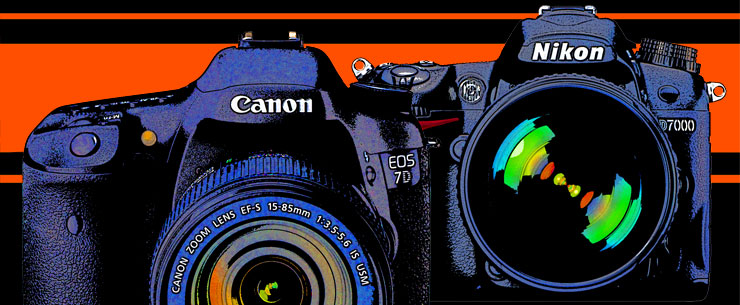
Recently, I published a quick comparison of the new Nikon D7000 and the equally new Canon 60D, both similarly priced mid-range cameras from their respective manufacturers. The Nikon fared very well against the Canon 60D. However, in several recent reports, I’ve begun to see the D7000 compared to the Canon 7D instead… and the 7D is a much harder act to follow. Some have claimed that the Nikon is just as good as the 7D at $400 less.
It is easy to get caught up in the hype surrounding a new camera, especially when it hasn’t even been released to the public. But lets take a more sober look at the features and build of the two powerhouses and see if they can really be considered equals.
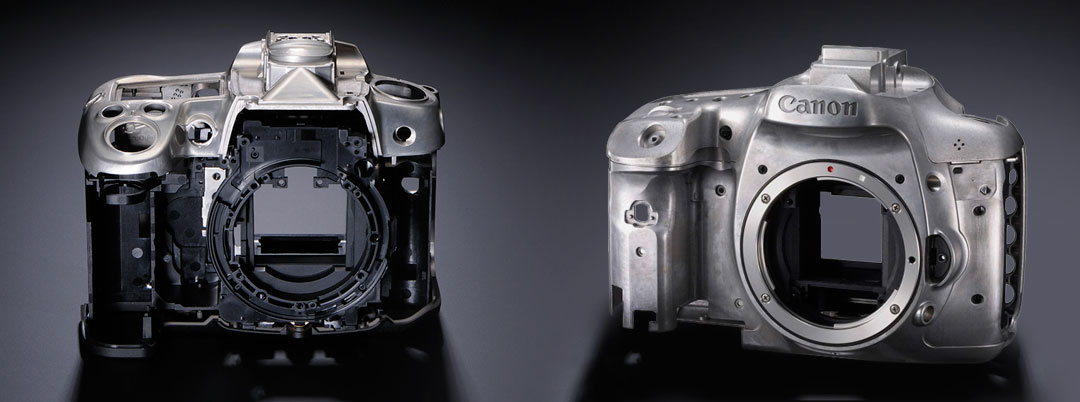
Thought both camera bodies can claim magnesium alloy body construction, that construction is not necessarily equivalent. Notice that the Canon's lens mount is bolstered by the magnesium alloy body.
First, lets take a quick look at the bodies. Although the Nikon D7000 is advertised as having a magnesium alloy body (and it does), it is more of a skeleton than the full metal body of the Canon 7D. As you can see in the photo (sorry for the hasty composite), the 7D is metal all the way up to the lens mount, where the stress from heavy glass can make the greatest impact. The D7000, on the other hand, has magnesium armor in many crucial areas of the body, especially along the top and back of the camera, but its front (and importantly, surrounding the lens mount) is still primarily plastic. The D7000′s body, then, is a great step up for the advanced amateur, but it is still not quite professional class construction. No doubt the smaller size of the D7000 played an important part in the body design.
Though both cameras offer a bright penta-prism viewfinder that show 100% of the full frame, the Canon shows the image at full magnification, while the D7000 is 5% smaller. For those of you who spend hours each day staring through your viewfinder, you’ll understand why this makes a significant difference… bigger, brighter viewfinders are always better.
Now, some of the features:
| Canon 7D | Nikon D7000 | |
|---|---|---|
| Amazon Price | $1599 | $1199 |
B&H Price![]() ![]() | $1599 | $1199 |
| Body Material | Magnesium Alloy | Magnesium Alloy & Polycarbonate |
| LCD Size / Resolution | 3.0" 920,000 pixels | 3.0" 921,000 pixels |
| LCD Articulated? | No | No |
| Sensor Size | 14.9 x 22.3mm (APS-C) | 15.8 x 23.6mm (APS-C) |
| Crop Factor | 1.6x | 1.5x |
| Sensor Resolution | 18 Megapixels | 16 Megapixels |
| ISO Range | 100-6400 +12800 | 100-6400 +12800 +25600 |
| Total AF Focus Points | 19 | 39 |
| Cross-Type AF Sensors | 19 (dual diagonal) | 9 |
| AF Light Level Range | -.05 to +18 EV | -1 to +19 EV |
| Metering System | 63 Zone Point Linked Evaluative 9.4% Center Weighted 2.3% Spot | 2016 pixel RGB Metering Sensor |
| Exposure Compensation | 1/2 or 1/3 stops via thumb dial | 1/2 or 1/3 stops via button-dial combo |
| Auto-Bracketing / HDR Options | ||
| Max Frame Rate : RAW (14-bit) | 8 fps | ? |
| Max Frame Rate : RAW (12-bit) | n/a | 6? |
| Max Frame Rate : JPG | 8 fps | 6? |
| Max Burst Duration RAW (at highest frame rate) | 15 | 100? |
| Max Burst Duration JPG (at highest frame rate) | 94 | 100 |
| Shutter Speed Range | 1/8000th - 30 sec. +bulb | 1/8000th - 30 sec. +bulb |
| Maximum Flash Sync Shutter Speed (standard flash) | 1/250th sec. | 1/250th sec. |
| HD Video Resolutions | 1080p, 720p | 1080p, 720p |
| Available HD Video Frame Rates | PAL and NTSC 24/25, 30 at 1080p 24/25, 30, 60 at 720p | 24 fps at 1080p, 24, 30 fps at 720p |
| Firmware Sidecar Available | Under Development | No |
| Media Type | Compact Flash | SD / SDHC / SDXC (2 slots) |
| Weight | 820g (body only) | 690g (body only) 780g with battery |
| Viewfinder Coverage | 100% Frame, 1.0x magnification | 100% Frame, .95x magnification |
Obviously, the Canon 7D has a higher resolution sensor, at 18 megapixels compared to the D7000′s 16. The Nikon’s sensor can be pushed (H2) all the way to ISO 25600, though having seen the results, it’s hard to imagine that anyone would want to. Otherwise, the cameras have the same ISO range, 100-6400. I’ve found that images from the 7D shot up to ISO 1600 (and sometimes 3200) are quite usable. I look forward to seeing how the D7000‘s high ISO images compare. As it is a newer sensor and lower resolution, we should expect the D7000 to have slightly better high-ISO performance than the Canon 7D… and my initial tests seem to indicate that this is true, especially at ISO 6400.
[Update: After numerous early reports of hot-pixels on the D7000, Nikon has released a firmware update to help correct the issue. They say that it may not correct the problem entirely, but it should make them much less problematic. You can upgrade your firmware here: Nikon D7000 firmware update .]
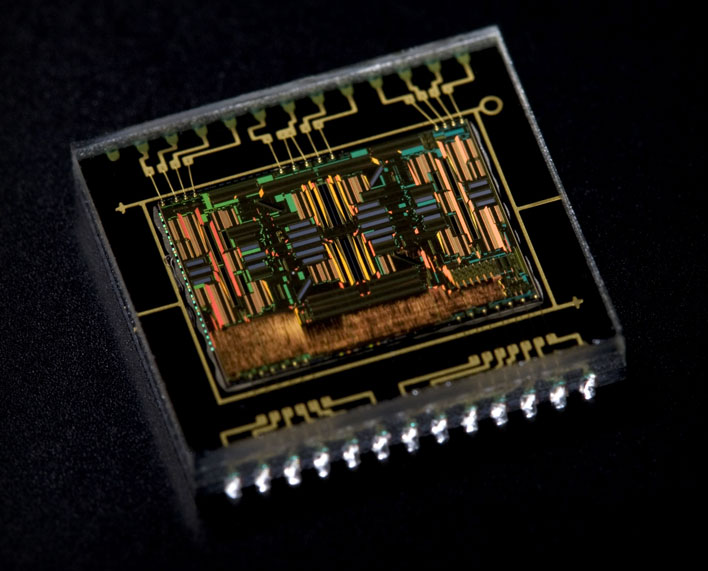
The D7000 does have an interesting new 39 point, RGB inclusive AF system. However, it still only has 9 cross-type AF sensors, which make a crucial difference in low light, low contrast situations. The Canon 7D has more than double that number of cross-type points (19 dual cross-type, in fact), and an AF system borrowed from the Canon EOS 1D line, probably the world’s most popular and successful line of sports photography cameras, driven by dual Digic-4 processors. Though it’s likely that the Nikon will perform almost as well as the 7D in good light, I would put my money on the 7D in lower, flatter lighting situations.
[Update: This point was a little quick, and since there have been a couple of questions, I'm going to explain this conclusion in a little more depth.
As you undoubtedly know, contrast is the fundamental ingredient for auto focus in SLRs.
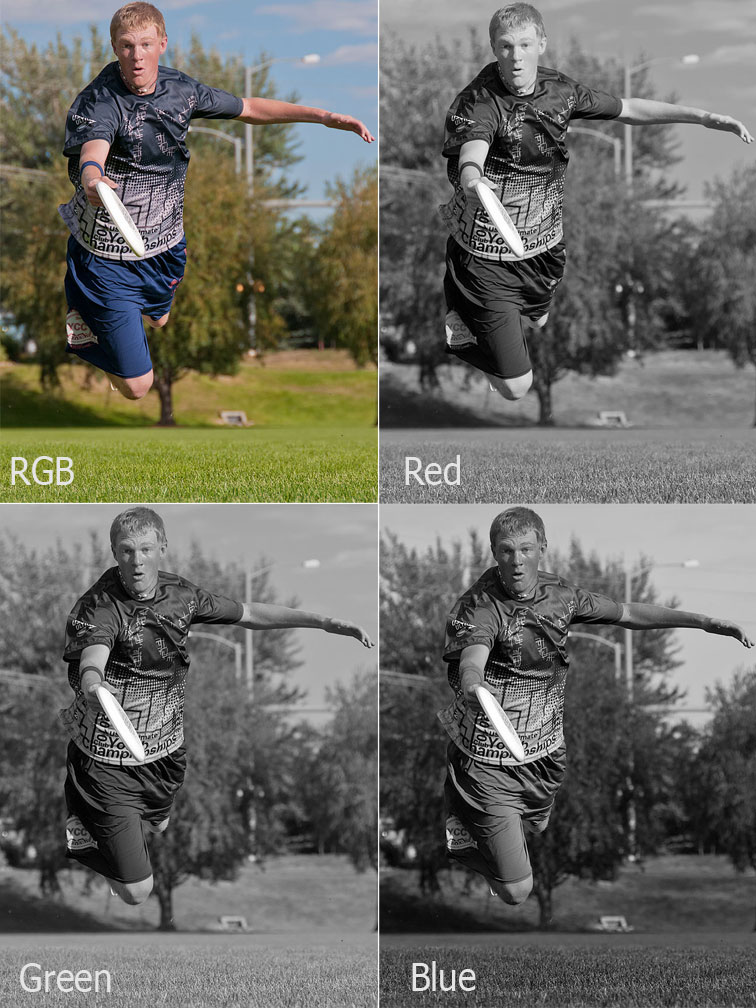
If we consider our subject's face to be our desired focal point, then clearly the red channel gives the best contrast between skin and background, which is typical with skin. We also get good contrast against the sky in the blue channel. The skin tones are low contrast in the green channel, but this is the best case scenario for the green channel, with an almost entirely green background.
Stop and think for a few moments about what a color RGB image is, or better yet, open a few images in Photoshop and take a look at the “Channels” palette. An RGB image is composed of 3 black and white channels, one corresponding to each primary. As you may know, you can duplicate your red channel and replace your blue channel with it, for example… there is nothing inherently “red” or “blue” about each one. Instead, each one is like a black and white photo shot with a colored filter, so they have differing levels of contrast. Since CMOS and CCD sensors use about twice as many green receptors as any other (because of the way that our eyes see) the green channel usually has the most detail information, but the lowest contrast. Again, those of you who do a lot of isolating and masking in Photoshop know that green is the channel least likely to be used to create a new mask.
The 7D does use the color data to assist in AF; it uses the high contrast Red and Blue channels (its metering sensor uses two layers, an RG and a BG). The Nikon uses all three channels, ie, the full RGB spectrum, but keep in mind that because the green channel is typically low contrast, it’s not usually going to be any more useful than the composite RGB brightness data that our cameras have always used; I take the fact that it claims to be RGB as more of a gimmick than an actual engineering feat. So, on the basis of color data, there will be (extremely) few circumstances in practical use when the added color channel will be helpful in pulling focus… if any.
On the other hand, the Canon 7D uses 19 cross-type sensors (rather than just horizontal). Nikon clearly understands the importance of cross-types; they gave the D300s 15 of them in its 51 point array. I’ve been shooting with this camera exclusively for the past two months, and the AF is wonderful. So why not give them to the D7000? The obvious reason is that they’re expensive, and that the D7000′s AF system is intended to be slightly scaled down (fewer AF points, fewer cross type sensors) from the much more expensive D300s (RGB aside). So, there is no reason to think that the D7000′s RGB system will produce better results than Canon’s color assisted AF, but there is a very serious reason to believe that the 7D’s 19 cross-type sensors will out-perform the D7000′s 9. ]
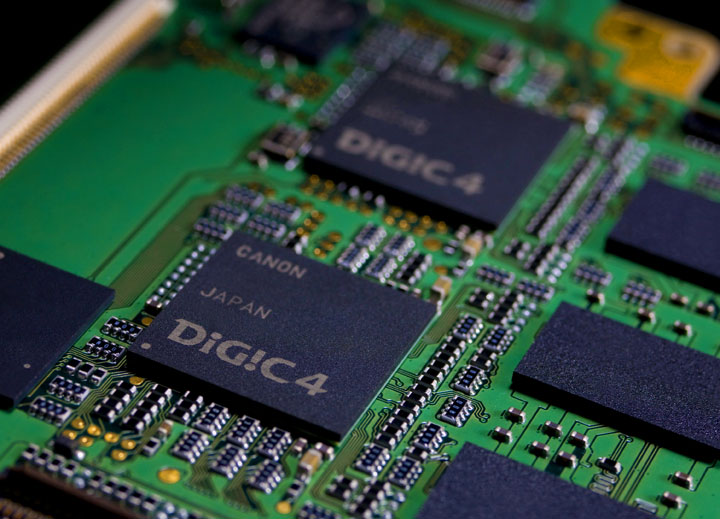
The dual processors of the Canon 7D also mean that it should perform faster in general. It can shoot faster bursts of photos (8 per second vs. the 6 of the Nikon D7000). The D7000 does allow bursts for a slightly longer duration (100 vs. 94 jpgs), which makes sense: since it’s taking fewer photos per second, it doesn’t have to write the data as fast, and the buffer will have more time to clear. Nikon, however, is suspiciously vague about the resolution and format of those photos. In this matter, I’m keeping in mind that the Nikon D300s advertises being able to shoot 8 frames per second, but it can only shoot 2.5 in RAW mode (unlike the 7D, which shoots 8 fps in RAW or jpg).
Video

For those of you who are serious about making production-quality movies, I can highly recommend ##http://www.bhphotovideo.com/find/hdslr.jsp?BI=5256&KW=&KBID=6027##B&H's HDSLR guide##. It covers all of the extras that are really important for slick results: audio, matte boxes, stabilizers, rails, etc. Even if you're not in the market, it's worth looking... lots of cool toys!
The 7D can also process video faster, allowing it to shoot 60 frame-per-second slow-motion HD video (at 720p). Perhaps more importantly, the D7000 can only shoot 1080p video at 24 fps (not 25 or 30), which is a major limitation. Although some film makers prefer working with 24 fps because of its similarity to the movie film frame rate, 30 fps (30p/60i) is the standard broadcast frame rate, and common video editing frame rate. If you intend to edit video footage together from the D7000 with camcorder video, you’ll have your work cut out for you.
One advantage of the Nikon D7000, however, is the sensitivity of its focusing sensors. According to the specs, the Nikon can focus in a half (0.5) EV lower light than the Canon, which can always come in handy. This is, of course, assuming that in the available light there is sufficient contrast, etc, for the sensors to pull focus. The D7000 also uses SD cards, which some may find to be an advantage, and it holds two of them, allowing physical separation of jpgs and RAW files. I think this is a really cool idea, but I’m not really sure how useful it will be in practice… I can’t think of a good practical application for the way I work.
There are, of course, countless other differences between the two cameras… but many of them are hard to quantify, and many of them are not used by many photographers. I’m willing to accept that there may be particular features found in the D7000 that will make it the best choice for a particular photographer, but when it comes down it to the raw figures, the Canon 7D appears to be the clear winner. Perhaps not by a ton, but certainly $300 worth.




Hi Matthew
Great post, if we add another camera into the mix the Nikon D300s with its 51 point AF system with 15 cross type sensors would you choose the Canon 7d or the Nikon D300s? I am looking to purchase either for my birthday in July. Would you also expect a replacement for either camera in 2011?
Many thanks
I actually wrote a similar comparison between the 7D and D300s, here. Again, I think that the 7D comes out on top, but not by an overwhelming margin. The cameras are all very impressive. I wouldn’t be surprised if the D300s or the 7D saw a replacement (or update, at least) this year. They’re both a couple of years old, which puts them in line to be replaced, though Nikon may be waiting until the buzz over the D7000 dies down a little. The D300 was released less than 2 years after the D200, and the D300s was announced a little less than two years after that (July 2009). I’d say that puts the announcement of the D300x or D400 any day now, but who knows, especially with the Tsunami.
Canon has announced the EOS 10D – 60D in August or February, usually 12 or 18 months in between models. The 7D was released in November 2009, but of course, is not part of the x0D series, so there’s no precedent on which to base predictions.
- Matthew
I’m looking at the Canon 7D and the Nikon D7000 so I was attracted to this thread. I was thinking of the 7D with a Tamron SP AF 17-50mm f/2.8 XR DI-II VC. What are your thoughts?
That sounds like a good combination; you may have noticed that that lens is in my “Lens Recommendations” section (under mid-range). It’s a nice combination of performance and price.
- Matthew
Okay, let me ask another. I am looking at the Canon 7D and the NIkon D7000. I was attracted to the 7D because I’d like to do large landscape prints for our retirement home in a few years. I would ideally want a full frame, but I’m a teacher and the 7D is pushing it. I figured that the 18 MP would give me more crop room, and still allow a larger print than the 16 MP of the Nikon. However, after reading through a lot of data at http://www.dxomark.com/index.php I’m not so sure. I guess what I am questioning is the fact that the Nikon has less pixels, but it has a larger sensor. Whereas, the Canon has more pixels crammed into a smaller sensor. I do realize that I’ll be pushing the print size beyond “photographic quality,” but I think that taking in the viewing range of the larger prints it won’t hurt that much. However, I do want the best image quality for that size print that I can get. Which do you feel would provide that?
In both cases, the quality of the photo is going to be limited by the lens and shooting technique more than the sensor (or anything else). The difference between 16 and 18 megapixels isn’t really going to be very significant. Tests like DxO may say that one sensor is better than another, but the fact is that you can take really amazing photos with any of these cameras… and if someone is having trouble getting good image quality, it’s more likely to be a problem with the photographer than the camera.
With the highest resolution lenses, the Canon might have a slight edge, particularly at low ISO. The noise on the D7000 is a little lower above 1600, but in both cases, the image quality isn’t that great … so it should be avoided if possible.
If you’re really interested in printing large, keep in mind that it’s a relatively simple matter to stitch together 2 or 3 (or many more) photos into a large image, if you expose with that in mind. That way, you can get a 50+ megapixel image, which will actually look significantly better than a 16 or 18 one.
Alternately, you might look at the Sony A850. It’s a 24 megapixel, full frame body (same sensor as used in the D3x, and it costs under $2000 (just a hair, though). Or, sometime within the next year or so the 5D Mark III will probably be released, so the Mark II prices will drop, and they’ll be widely available used.
That said, I think that you’d be very happy with a 7D or D7000; I’d buy according to the lenses that you want to invest in later, the features that are most important to you, and whether the controls are comfortable and intuitive for you.
- Matthew
Thank you for your posts. I want to upgrade my old Nikon D50 but which one the D7000 or the 7D. Primarily I use a camera for taking photographs of stud bulls and cattle but I am a keen photographer as well. I will purchase a 18 – 200mm lens as this is the most useful. Too long and I miss shots that are closer and too short I cant get close enough sometimes. I find with my dear old camera that it often has trouble focusing on the shiny coats of the bulls that are usually a red-orange colour but not very dark like some cattle. Not being a highly technical person I don’t really understand about the deference between the focus points/ cross points of the two cameras so wonder which one would be best for my needs?. It is good to have the whole animal in focus not just his head so I do use the multiple focus point capability of my old camera. Its also good to use aperture to blur the background if possible in usually very bright light. Most shots are taken side on for conformation but 3/4 are useful too. I do need something fast because the flick of an ear is the difference between a usable pic and one that is not and I might only get one chance. I do have a couple of Nikon lenses 18-55 & 70 – 300 but use mostly the 18 – 55 once the bulls accept me and the 70 – 300 when they don’t or I want dramatic 3/4 shots.(I have a 28 – 200 Tamron but it rarely focuses sharp enough) I think I would hardly take the 18 – 200 off so maybe the other lenses will not be so important anyway and they are so old that they don’t have any vibration reduction. (not even sure if they are f mounts – how do you tell?) i would also use the video for short 10 – 20 sec grabs of bulls walking – I do that now with an camcorder on a tripod – it focuses by itself and is simple.
I notice that you are a Canon fan anyway and the only people with similar cameras that I know tend to say that they just like using a Canon and that both cameras would be good. I’m a little worried about the weight but expect that you would get used to it. I do need something very tough because it will bump around in the back of a motor bike or seat of a ute and be exposed to heaps of dust. I have lost my Nikon off the back of a bike when I hit a bump (in a padded case) and it was fine. Love to here from you.
Hi Catherine,
Unfortunately, no matter what camera you use, focusing on the coat of a bull will be difficult because a focusing point needs contrast to focus (so solid colors are hard to focus on, but anything with lines is a lot easier). The average (non-cross type) focusing point can focus on vertical lines, but has trouble with horizontal (or no lines at all, of course). Cross-type points can focus on horizontal OR vertical lines with relative ease. So, anything like the head of the animal, which has details (and therefore outlines) to focus on is relatively easy for a camera to focus on; and honestly, either of these cameras would easily be up to that challenge. If you try to focus directly on the side, you may do fine if there’s some visible detail (either pattern in the hide or visible ribs, etc), and if you’re taking a shot of the whole animal, you should be able to focus on the line between the back of the animal and the background. Again, though, both of these cameras have a sufficient number of cross-type points that you should get about the same performance with either camera…. so I wouldn’t worry to much about that.
When it comes to video features, they should also both suit your needs equally well. For Americans, the Canon is a little better for NTSC standard 30fps video at 1080p Full HD, but I’m assuming that you’re Australian, so I’m not even sure if NTSC standards would be a going issue; either way… you’ll be able to shoot at 24fps, which is the motion picture standard, so if you want to put a video on a BluRay disc, for example, to give to a potential buyer… you can do that with either camera. I’ve tried using the full-time AF on the Nikon, and it’s disappointingly slow… so you’ll probably mostly be using manual focus for video in either case. The Canon requires you to hold down the button half way for it to focus, the Nikon will try to pull focus all the time if you want it to, but it doesn’t do a great job. You may find that, unless you want really high quality HD video, you might find it easier to continue using a video camera.
As for lenses… if your old lenses fit onto your D50, they’ll fit onto a D7000… no problem there.
In the end, they’re both going to be quite a bit better than your D50, and I’m sure that you’d be really happy with either one. The Canon is slightly faster (more frames per second, but it’s probably not a practical difference for your needs) and is a little more heavy-duty, but again, they’re both well built. Since you already have Nikon equipment, I’d probably opt for the D7000; it will be easier to get familiar with, and it will fit your current lenses.
I should tell you, though, that the Nikon 18-200 is the bane of my existence. It might not make a difference to you, but at wide angle, the borders of the image are horribly soft and smeary. Fair warning
Good luck!
- Matthew
Thank you Matthew,
Yes Australian. With the Nikon 18 – 200, is it just the border of the frame or the subject? Would the Canon equivilent be any better? I do like my 300 mm lens as it is handy at times so I probably will go for Nikon then.
Thanks again
Catherine
It’s really just the borders; the center of the frame remains pretty sharp, and actually the borders are sharper if you stop down to f8 or so.The Canon lens also has optical problems… that’s the problem with trying to get such a huge zoom range into a single lens; there are always trade-offs. Still, it’s very convenient, and for many photos, it doesn’t matter if the borders are a bit soft.
- Matthew
Thank you Matthew,
Now I’ve discovered the new Nikon 28 -300mm lens so I’m really torn. Considering the dust factor of changing lens etc I think I might be better off with it. I’d still have the old 18 – 55 if I really need it. I did use an old Tamron 28 – 200 until I realised it just didn’t cut if for sharpness and mostly I didn’t lose shots for being too close.
Thanks again
Catherine
Hey Catherine, I know you weren’t asking about other lenses and just wanted a response from Matthew, but it sounds like you’ve never tried out a fast telephoto lens. You should see if you can find someone to lend you one or try renting one for a day. A new Nikon 85mm 1.8 is under $500, and used 3rd party 70-200 2.8 lenses can often be found on eBay for $500-$600, which is significantly less than Nikon’s 18-200 or 28-300. The superzooms have VR, which can be handy in some situations, but the way you can blur out the backgrounds with a fast lens is such a huge plus I think you should at least try one out before you decide to purchase a superzoom. An added benefit of shooting with a fast lens is that even if the lens is not super sharp at the pixel level, the perceived sharpness is higher when the out of focus areas are blurry!
Well I do like nikon primes… Can you also suggest a prime lens for Canon that can be used for walk-around? my bugget for the lens is about $500.
35 f2 and 85 f1.8 rock if you have a full frame camera. Personally I think those two lenses and a 5D mark I are the best value camera kit going right now.
Thanks for the reply. I’m from the Philippines by the way and these 2 cameras here have the same price. Disregarding the video performance on both, since I would only use it to take photos, would you still recommend the 7D? I’ll use it mainly for portraits and a bit of landscape.
Yes, I’d definitely get the 7D. The only reason that I’d consider the Nikon is if a) there’s a particular Nikon lens or set of lenses that you like that are made by Nikon, or b) you do a lot of high-ISO work, because the D7000 may have a slight advantage there.
Hope you enjoy it!
- Matthew Gore
Hey Ron! What’s up buddy? You’re from the Philippines, so do I. lol
I wanted to know how much is the current price of brand new 7D and D7000 in Manila?
I’m over here in Dubai and I’m curious about the prices over there.
I’d be buying one soon, just having a hard time choosing between the two though lol.
Thanks
If you have opportunity, buy your camera in Hong Kong from a reliable shop. Suntek Camera is one. They could be up to US$500 or cheaper than in the Philippines whether it is Nikon or Canon. But be careful dealing with those Hong Kong salesman.
If you want an amazing portraits the Canon 5D mark II is the way to go.