The Differences That Matter
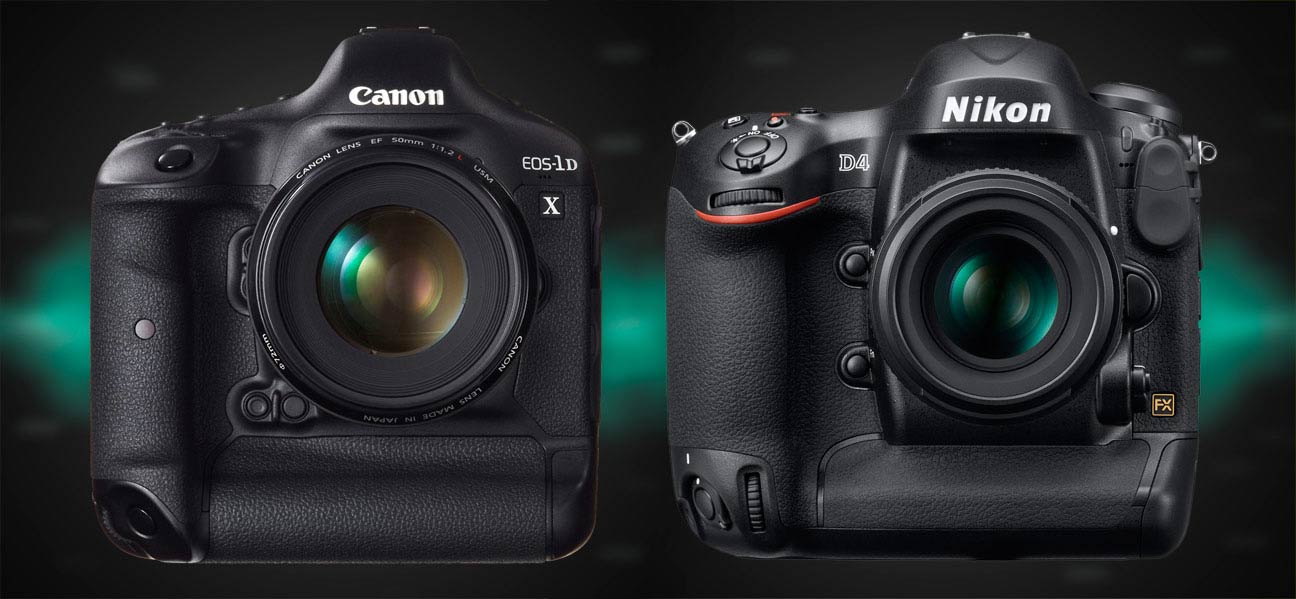
If there were ever two cameras that seemed destined to be compared, they are the Canon 1DX and the Nikon D4. These two titans have so many similarities that my mind has already conjured up numerous tales of corporate espionage to explain them. But before I continue, let me be clear: both cameras are amazing pieces of equipment, and both promise to be such great tools that it is almost foolish to ask whether one is better than the other. Take this article as a means of satisfying my curiosity rather than an attempt to persuade the reader that one is “better” than the other.
There is one further point that I’d like to make before getting started. The margins of difference between many of the factors discussed below are small enough that many people will ask “How often will that make any practical difference?”, and the answer will be “Rarely, if ever.” I suggest that you ignore that concern, for the moment. For many people who are willing to spend $6000 on a camera body and whose livelihoods depend on those rare circumstances, they’re important. In all of my years as a photographer, I don’t think I’ve ever dropped my camera so hard that it needed a magnesium alloy body to hold together; but that doesn’t mean I’d want to go into the field without it. This is not to say that every difference should be considered consequential, but at this level, those differences should not be dismissed off-hand, either.
The Numbers
Let me begin by looking at some of the major features of the two cameras, starting with those that are most important in a professional camera aimed at news and action shooters: speed, autofocus, and low-light capabilities.
| Canon EOS 1DX | Nikon D4 | |
|---|---|---|
  |   |
|
| Price: | $6800 | $6000 |
| Sensor Resolution: | 18 Megapixel | 16 Megapixel |
| Native ISO Range | 100-51200 | 100-12800 |
| Expandable ISO Range | 50-204800 | 50-204800 |
| Auto-Focus Points | 61 | 51 |
| Cross-Type Points | 41 (5 diagonal) | 15 |
| Minimum Auto-Focus Light Levels | -2 EV | -2 EV |
| Smallest Aperture that Allows AF | Max. Aperture of f5.6 | Max aperture of f/8 (11 focus points; 5 in the center, 3 on each side) This is important for people using tele-extenders on small aperture lenses. |
| Maximum Frame Rate: | 14 fps (high speed mode) 12 fps shooting RAW | 10 fps, 11 with AF locked |
| Shutter Release Lag: | 55ms standard 36ms via "shortened release lag" custom function | 42ms |
| Expected Shutter Life: | 400,000 shots | 400,000 shots |
| Metering Sensor: | 107,250 pixel RGB | 91,000 RGB |
| Video Size and Rates | 1080p 24/25/30fps 720p 60fps Max duration: 29 min. 59 sec. | 1080p 24/25/30fps 720p 60fps Max duration: 29 min. 59 sec. |
| Video Type | .h264 codec with choice of 2 compression types: 1.IPB , smaller file size 2.ALL-I , higher image quality, larger file size | .h264 codec with B-frame type compression for ease of editing, .mov |
| Video ISO Range | 100-51200 | 200-204800 |
| Audio: | Stereo External Mono Internal Auto or Manual Levels A/V Out | Stereo External Mono Internal Auto or Manual Levels Stereo headphone jack |
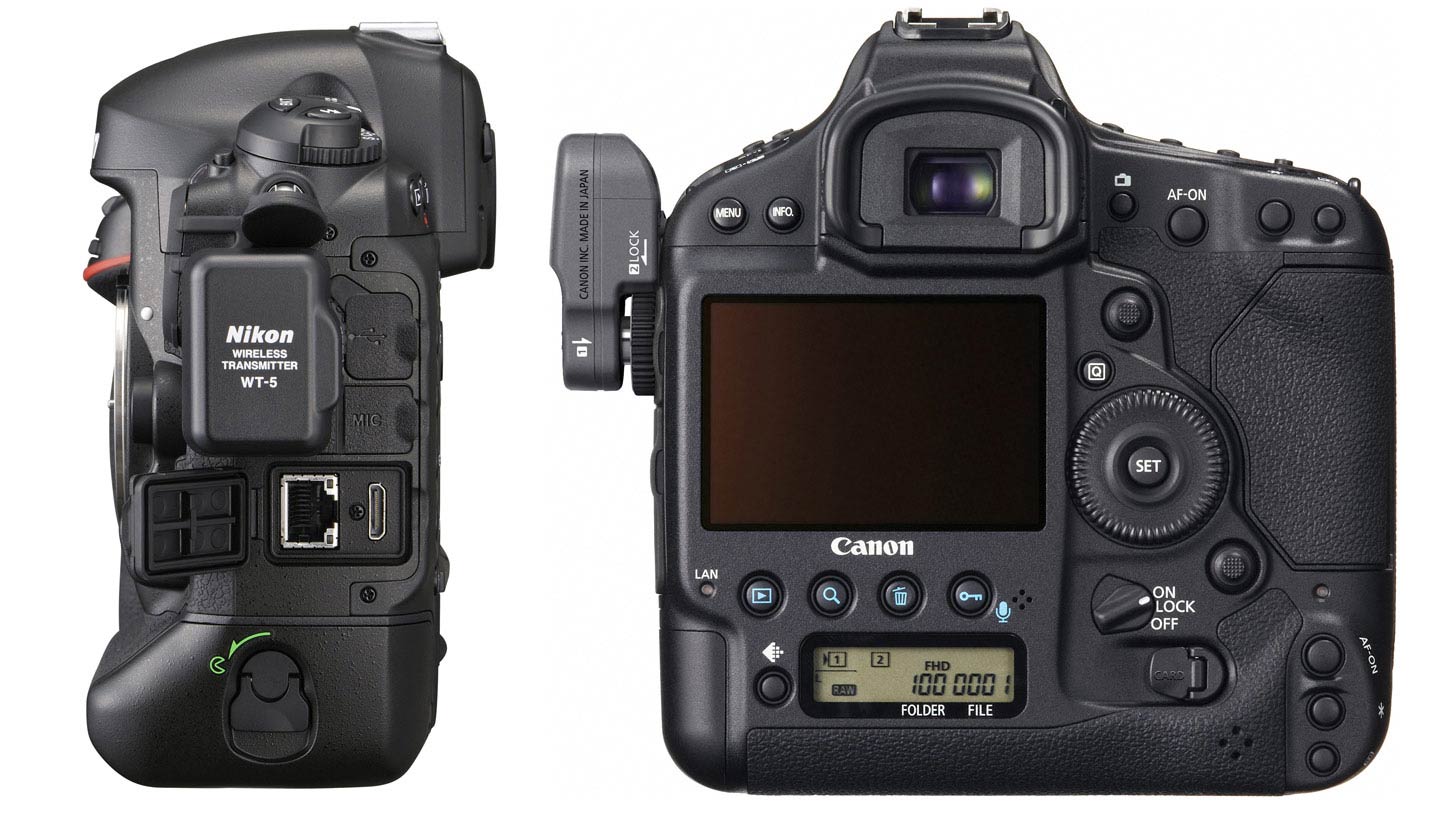
| Connectivity: | Wireless with accessory Canon WFT-E6A Gigabit LAN jack | Wireless with accessory Nikon WT-5 Gigabit LAN jack |
| Time-Lapse Mode | No, external intervalometer required. | Yes, Built-In. |
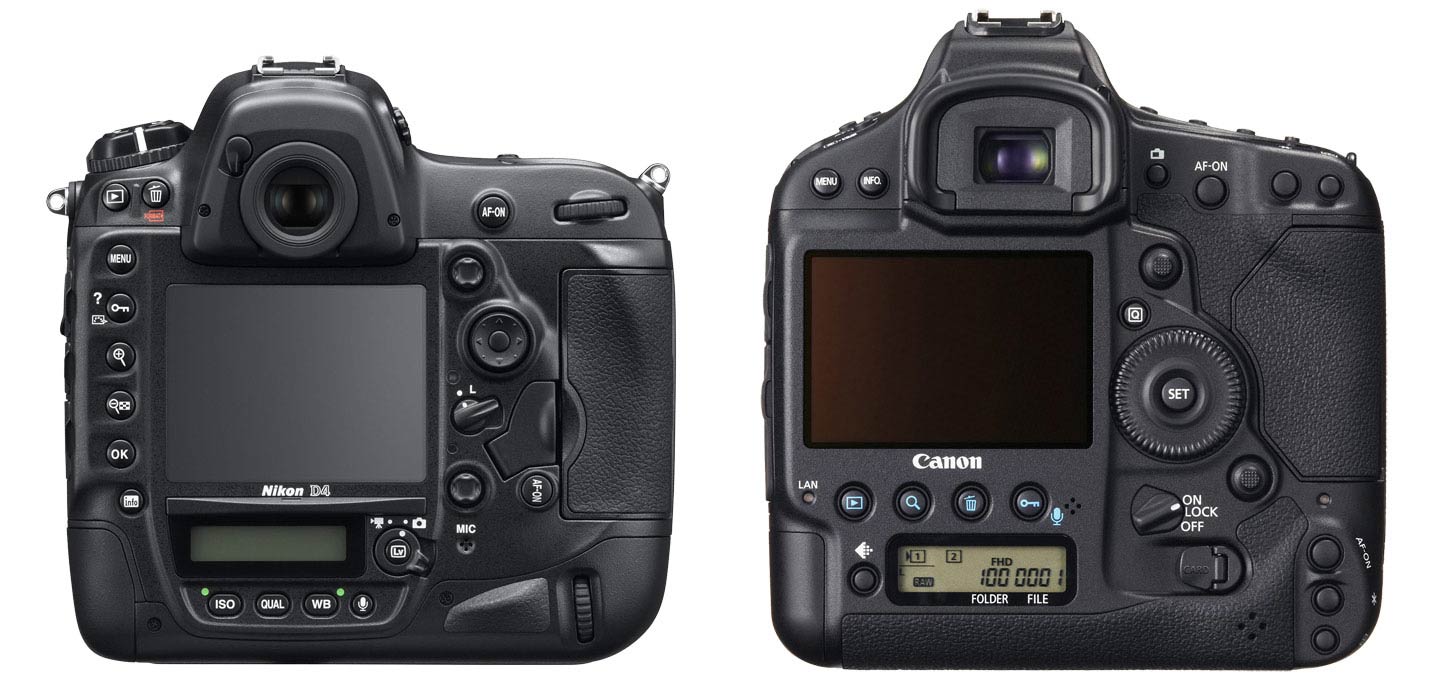
| Viewfinder: | Pentaprism, .76x magnification | Pentaprism, .70x magnification |
| Memory Slots | 2 Compact Flash | 2: 1 Compact Flash, 1 XQD |
Low Light
When it comes to sensor performance in low light levels, it initially appears that Canon will have the advantage, as it has two extra stops of native ISO range, and image quality has typically dropped off very quickly in the extended ISO range of earlier models. However, this may be deceptive, as both cameras reach the identical top extended ISO range. It’s possible that Canon has simply opted to include two stop of extended range in their native range. It’s also possible that the Nikon’s noise handling is simply good enough that it will out-perform the Canon, even with two stops of difference… though I don’t currently have any reason to believe that that’s the case (or even likely).
Canon has the advantage of a higher resolution sensor, however. Down-sampling images, when done correctly, will significantly improve sharpness and reduce noise, so even if sensor performance is similar at native resolutions, Canon may be able to make up some ground after-the fact. At this point, however, I’m merely speculating. Until both cameras are available for testing, we won’t know who will win out at high ISO.
When using large aperture lenses, both cameras can auto-focus in remarkably low light levels; -2EV is roughly equivalent to the amount of light you’d get on a clear night under a full moon. However, the Nikon D4 does have a clear advantage when focusing small aperture lenses. If you were shooting Canon with a 400mm f/4 lens and wanted to add on a 2x tele-extender, you’d have to switch to manual focus, since the 1DX can only reliably auto-focus (reliably) when the lens’ maximum aperture is f/5.6 or larger and a 2x extender reduces the amount of light getting to the sensor by two stops, effectively making the lens an f/8 maximum aperture. Eleven of the D4’s 51 AF points, however, will continue working even at f/8 light levels, according to Nikon.
Speed
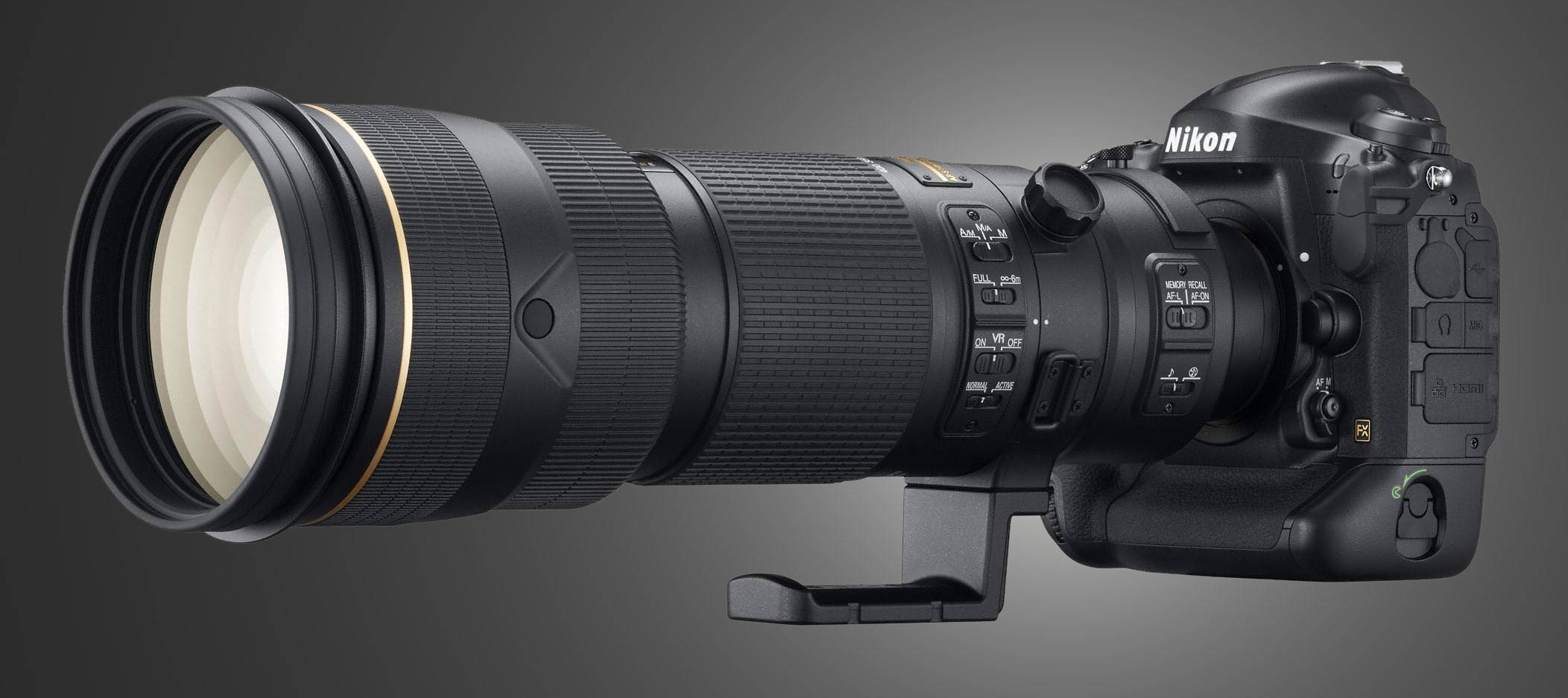
It is no accident that we see so many big white lenses as professional sporting events. Canon has a history of making fast, responsive cameras and lenses, and again, the Canon 1DX follows in this tradition. It has an excellent shutter lag, and it’s shooting rate, at 14 fps, is unrivaled.
Autofocus
The Nikon D4 and Canon 1DX both boast impressive new auto-focus systems with 51 and 61 AF points, respectively. The ten point difference may not be overwhelmingly important in itself, but there is one difference that is: while only the center 15 focusing points on the Nikon are cross-type, 41 AF points on the Canon are. Additionally, 5 of the Canon’s center points are oriented diagonally, which allows the sensor to quickly pull focus on horizontal, vertical, and diagonal lines.
Autofocus performance is of such a high priority to the 1DX that its AF system has been given a dedicated Digic 4 processor in addition to the dual Digic 5 processors that handle the camera’s image processing. The processor handles a variety of AF processing tasks, such as face detection, an improved predictive AF system with obstruction detection, and even light-source adjustments. Under tungsten light, the focus module can make adjustments that will more accurately focus the warm shifted wavelengths of light or the cooler wavelengths of shaded natural light, increasing sharpness and reducing chromatic aberrations.
Nikon’s new Advanced Multi-CAM 3500FX is also impressive, though. As mentioned previously, it handles low light and small aperture lenses with aplomb, and can track 16 individual faces in the frame. Furthermore, the module offers continuous AF while shooting video, and regardless of how useful this feature may be in practical use, it is a feature still absent in Canon cameras.
In the End…
I don’t expect anybody to make a decision based on a brief review like this; any sane person would not buy a $6000+ camera body unless they were already a seasoned professional with a collection of lenses and brand preferences that will play a much more important role than the technical differences I can point to. Indeed, I’ve only mentioned a few of the factors that seem most important in the bodies, but photographers who rely on Nikon’s sophisticated CLS flash system will find that external factor just as important, as will those Canon shooters who have grown accustomed to the performance of their white telephoto lenses. For my money, if the high ISO performance of the 1DX is close to that of the D4, I would lean toward the 1DX, and if it is better, that would seal the deal.
As usual, I’m interested to hear your opinion on the matter, either way! Please leave your comments below.