T3i vs T2i ?
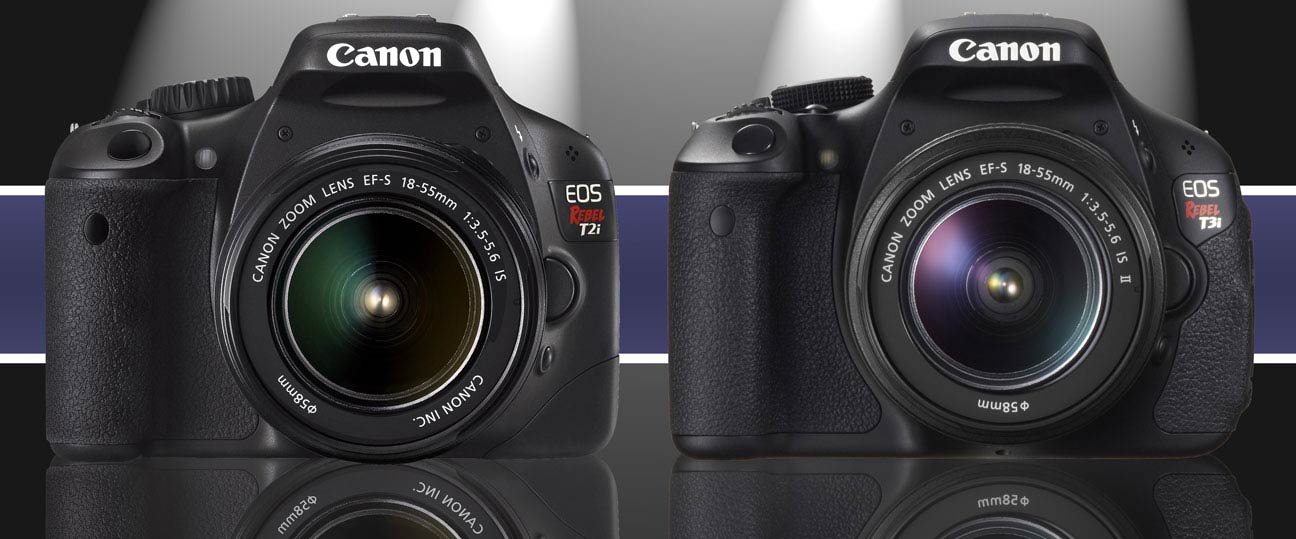
The Canon Rebel T3i is already on store shelves, even though the Canon T2i was announced just a year ago. Not surprisingly, the technological differences between the two are minimal, at least at first glance: they use the same sensor, image processor, and autofocus system. Yet the T2i is still available, and at only $579 for the body, it is a tempting offering. But when comparing the T3i vs T2i, is the T3i worth the extra cost? For some people it will be; for others it will be a waste of money. Below, I’ll very briefly note the differences between the two cameras and explain who will benefit from the T3i and who will be just as happy with the T2i.
[UPDATE : The release of the Canon T4i changes this picture significantly. Also see my comparison of the T3i and T4i here. ]
The Similarities
Before making a big deal about the differences, it’s worth noting that these two cameras are mostly identical when it comes to standard photographic operation, and there is no difference in RAW image quality between the two. The table below shows the functional similarities.
[To see the whole T2i vs T3i table, click in the drop down box which currently displays "10" and select "50"],
Canon Rebel T3i / 600D | Canon Rebel T2i / 550D |
|
|---|---|---|
![]() | ||
| Amazon Price (body) | $699 (Until Sept 3) | $639 |
| Body Material | Polycarbonate, Fiberglass Resin and Stainless Steel | Polycarbonate, Fiberglass Resin and Stainless Steel |
| LCD Size / Resolution | 3.0" 1,040,000 pixels | 3.0" 1,040,000 pixels |
| LCD Articulated? | Yes | No |
| Sensor Size | 14.9 x 22.3mm (APS-C) | 14.9 x 22.3mm (APS-C) |
| Crop Factor | 1.6x | 1.6x |
| Sensor Resolution | 18 Megapixels | 18 Megapixels |
| ISO Range | 100-6400 +12800 | 100-6400 +12800 |
| Total AF Focus Points | 9 | 9 |
| Cross-Type AF Sensors | 1 | 1 |
| AF Light Level Range | -.05 to +18 EV | -.05 to +18 EV |
| Metering System | 63 Zone Point Linked Evaluative 9% Center Weighted 4% Spot | 63 Zone Point Linked Evaluative 9% Center Weighted 4% Spot |
| Exposure Compensation | 1/2 or 1/3 stops | 1/2 or 1/3 stops |
| Max Frame Rate : RAW (14-bit) | 3.7 | 3.7 |
| Max Burst Duration RAW (at highest frame rate) | 6 | 6 |
| Max Burst Duration JPG (at highest frame rate) | 34 | 34 |
| Shutter Speed Range | 1/4000th - 30 sec. +bulb | 1/4000th - 30 sec. +bulb |
| Maximum Flash Sync Shutter Speed (standard flash) | 1/200th sec. | 1/200th sec. |
| HD Video Resolutions | 1080p, 720p | 1080p, 720p |
| Available HD Video Frame Rates | PAL and NTSC 24/25, 30 at 1080p 24/25, 30, 60 at 720p | PAL and NTSC 24/25, 30 at 1080p 24/25, 30, 60 at 720p |
| Media Type | SD / SDHC / SDXC | SD / SDHC / SDXC |
| Weight | 570g (including battery) | 530g (with battery and SD card) |
| Viewfinder Coverage | 95% 0.87x magnification | 95% 0.87x magnification |
| Built-In Wireless Strobe Control | Yes | No |
.
What’s New in the T3i?
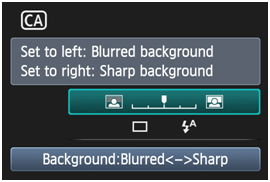
The two lines of text at the top of the LCD here represent the new “In-Camera Guide”
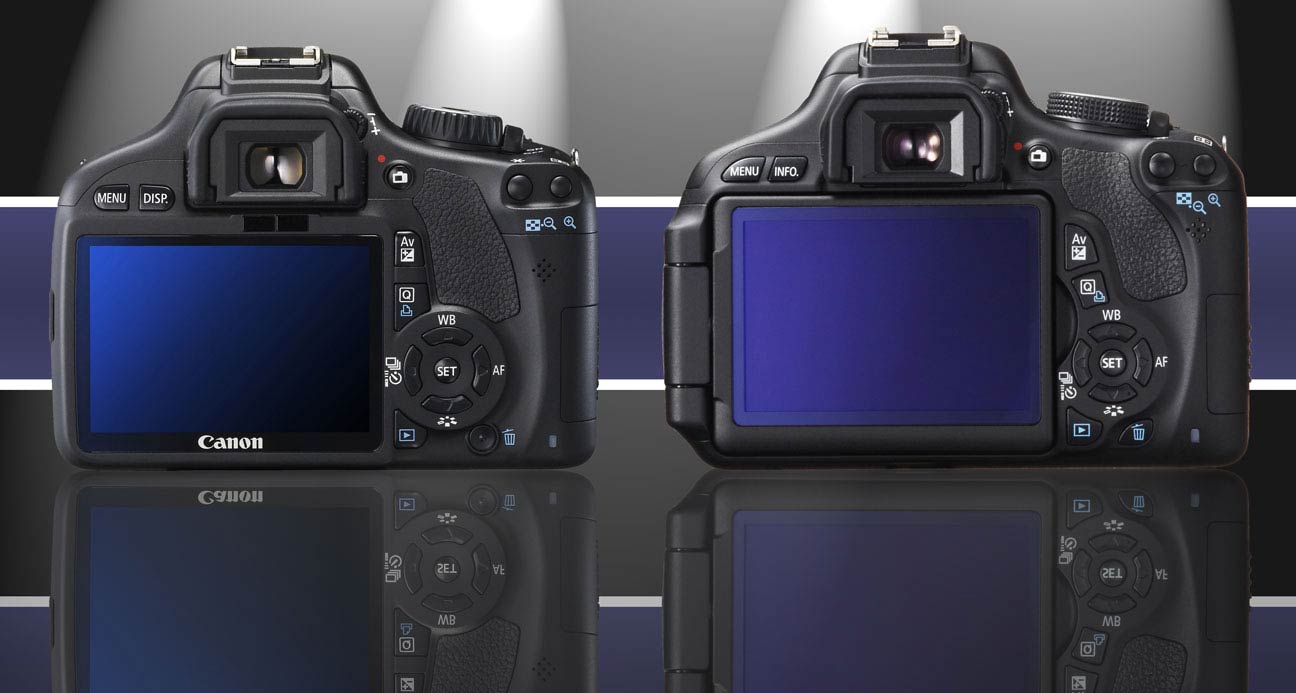
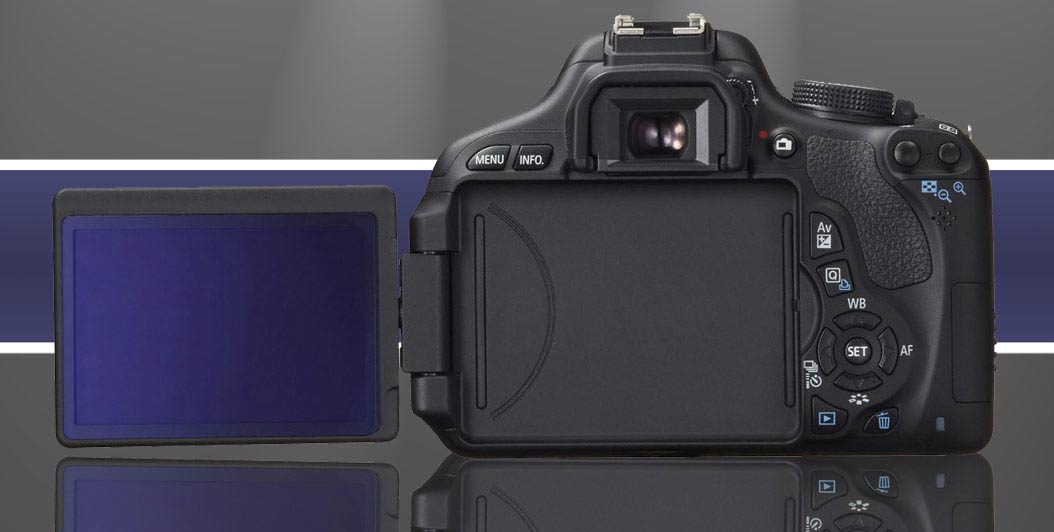
From the outside, the only major difference is the rear LCD. The new T3i sports an articulated LCD, much like that found on the Canon 60D. To accommodate the new LCD, the body is slightly deeper, and the whole unit weighs a hair more. Canon has also made some minor ergonomic changes, such as adding additional rubberized padding to bottom of the front left side of the body for extra comfort and protection.
Internally, there are a few more significant differences, though. These include:
- Native wireless control of off-camera flash (T2i requires accessory Canon ST-E2 module)
- Digital zoom for 1080p video, while recording. (Since 1080p video is only 2 megapixels, this can crop down to the center of the sensor, effectively providing a 3x – 10x zoom)
- Cropping mats for shooting in different aspect ratios
- “Video Snapshots”, which are short video clips assembled in-camera into an extended video
- In-Camera Guide, which provides information on the LCD panel that makes choosing alternative settings a little easier for beginners
- An image-database driven full-auto mode (A+) and some additional in-camera processing options, the “Creative Filters”.
Who Should Buy the T2i?
If you have used a 35mm film camera in the past and are simply looking to get a digital camera to do the same things, the T2i is probably for you. It’s no accident that this has been the best selling SLR in the world for much of the past year. The new video features in the T3i won’t be of use if you’re only interested in taking photos, and the auto settings and In-Camera Guide will not be relevant for those who already have a firm handle on photographic theory. Some photographers have also expressed concern about the articulated LCD of the T3i and 60D collecting dust or breaking off; and for those who work in rugged conditions, this may also be worth considering.
Photographers (like myself) who use radio-triggers for their flashes also needn’t worry too much about the native wireless flash control on the T3i (the exception being Radiopopper shooters, some of which translate the optical trigger signals from flash control units into radio signals).
On the other hand, you should go ahead and buy the T3i if you enjoy shooting video and think you’ll use the digital zoom. This is a feature that I’m actually very excited about myself; using a $100 50mm f1.8 lens as a 500mm f1.8 would open some incredible video opportunities (assuming that a stable tripod is available). Of course, you’re really only getting the same image quality that you’d get if you shot a photo and cropped in to the two megapixels in the center of the frame (1920 x 1080 pixel full HD video is about 2 megapixels), but on a low resolution display like HDTV, it could still look good.
Photographers who frequently shoot while holding their camera overhead will, of course, benefit from the T3i‘s swivel screen, as will video bloggers and others who want a handy video monitor while they’re in front of the camera. And, if you think that you’ll use the built in flash control, it would certainly save you money and hassle to buy the T3i.
If the automatic modes and In-Camera-Guide in the T3i are a deciding factor for you, though, you might alternatively consider a photography book, or better yet, enrollment in a photography course or seminar. Not only will it give you a better understanding of your camera and photographic theory, it may dramatically improve your photography in a dozen other ways.
I’ve tried to keep this comparison brief and simple, but please feel free to ask me any questions that you might have in the comment section below!
[UPDATE : The release of the Canon T4i changes this picture significantly. See my comparison of the T3i and T4i here. ]





Hello, I am also looking for some advice. I want to get into some amature photography myself, mostly portraits and outside pictures. I am debating between the t3i an the t2i as well, I am hoping to start a small buisness in a year or so after some courses and experience. I don’t want to cheep out if it will benefit me down the road. I also want to prior chase an external flash and would love some advice on that for what I am wanting to do. Thank you!
I meant purchase not prior chase.
Damn you, Auto-correct!
Hi Natisha,
My general advice is always to buy the least expensive camera that will fill your needs, and buy the best lenses you can afford. If you’re interested in portraits, though, then you’ll probably eventually want to start using off-camera flash (though at the moment, using flash might not sound appealing at all… once you learn how to use it well, it makes a huge difference). Since the T3i can act as a control module for off-camera eTTL flash, and the T2i can’t, that would push me over the edge for the T3i.
When it comes to flash, the canon 430ex ii is a good place to start. It’s reasonably priced, full featured, and although it doesn’t act as a commander for other flashes, your T3i will… so you can use the T3i to wirelessly control the 430 ex ii. I recently wrote a quick comparison of some other good flashes, if you’d like to take a look.
Good luck, and let me know if you have any other questions!
- Matthew
I am new at this and my future photography will consist of weddings, babies, and portraits. I am leaning toward the t3i. What lens should I buy first?
Thanks
Hi Jacqueline,
It really depends on two things: what else you have already, and whether you’ll shoot with off-camera flash.
My general advice is always to buy the least expensive camera that will fill your needs, and buy the best lenses you can afford… and if you’re going to shoot as a professional (which is what it sounds like your intention is), you’ll need some great lenses. So, I’m inclined to say, get the T2i and spend the money you’ve saved on better lenses or flash equipment. However, if you’re planning on shooting with off-camera eTTL flash (like wireless 430ex or 530ex IIs), the T3i can act as a control module, while the T2i can’t. A control module costs hundred of dollars, so you might as well buy the T3i if you plan to use it that way (and many people do). Otherwise, the T2i is pretty inexpensive right now… only $605 in a kit with the 18-55mm lens.
Those are my initial thoughts, anyway. I’d lean towards the T3i (currently $899 with the 18-55mm and 55-250mm), or the 60D if you can afford it.
- Matthew
I have read several of your comparisons, very educational. I am leaning towards the T2i and would appreciate your opinion on using this camera and what would be appropriate lenses and equipment in certain situations. Like a lot of people, I will have the usual special occasions and holiday pictures but my main concern is outfitting to cover the following scenarios.
1. Soccer in daylight hours, 20 to 50 yards away.
2. Soccer at night, with high school quality outdoor lighting, 20 to 50 yards away.
3. Volleyball, indoor gym lighting, 20 to 50 feet away.
I have used 35mm SLRs and now have an older non-SLR digital (not happy with low light shots) but treat me as as beginner.
Thanks
For soccer during the day, your have a lot of options. I’d probably go with something in the 300mm range (a 70-300 would be good), and it wouldn’t have to be particularly wide aperture, but a USM would be a good idea for any kind of sports. A 70-200 would be great too, though you’d get the best results on the near side of the field.
Soccer at night is hard, and at the very least, it requires an expensive lens or a serious flash setup. You’ll need a lens with a wide aperture, like an f/2.8, and even then, it will be tricky. Canon’s 70-200 f/2.8 would be a good choice, and you might want to use it with a monopod. Or, you could spend the extra $1000 on the IS II model.
If you take a look at the forum here, one of our members recently posted some photos of a shoot that he did at night in a relatively well lit football field, using that lens, and even then, he had a hard time getting fast enough shutter speeds to stop the action, even using very high ISO. So even an expensive lens isn’t a magic bullet, but without it, things would be much worse.
Actually, if you could make due without the reach of a 200mm, an 85mm f/1.8 would give you even more light, and for a lot less money, but it’s really not a great sports lens because of the lack of zoom and the limited telephoto range.
The same thing is generally true for indoor volleyball; it may seem light in a gym to the human eye, but to a camera, it’s quite dark. Since the court is so much smaller, you’re much more likely to be able to get away with a prime lens like a 50mm f/1.8 or f/1.4, which are relatively inexpensive and let in a lot of light, but you wouldn’t get the flexibility and range of a 70-200 f/2.8.
The other option is to set up flashes around the gym, and use radio-triggers to fire them. It’s an elaborate setup, but will generally give you the most control and best light in a gym. But explaining how to do it is probably beyond the scope of the comment section of this article
I know that’s a little bit broad, so let me know if you still have further questions
- Matthew
Matthew,
Thanks. I was afraid that there would be an expensive end to the low light sports situations. That is an expensive lens for non-professional family photographer (term used lightly) but, the information you have given will keep me from spending money on equipment that will not produce the desired results. You only get one shot at it (life and photographs), right?
I think I’ll save a little play money and go for your suggestion. That lens would also serve me well for the daytime soccer, right? Considering my three sports enviroments, this could be my most used lens. If you look at it that way, it’s not so bad.
The link to the members photos was a great help. I’d love to get shots that good. He was little hard on himself.
It’s nice to know there is someone out there that will spend their time helping with no personal gain expected. Thanks again.
The 85mm f/1.8 is an awesome portrait lens; that’s really what it’s designed for. It’s not much of a telephoto lens, though, so it’ll be great if your sports subjects are pretty close (and it will blur the background behind them nicely), but it will be hard to use for more distant subjects. An 85mm lens on a T2i or T3i would produce images more like a 135mm lens on a 35mm camera, though, so it’s better than it looks.
I hope you looked around and found Rob’s earlier set of photos, which he shot in the daylight, for comparison.
Good luck!
- Matthew
I should have been more specific. I was referring to the recomendation of the Canon 70-200 f/2.8. What do you think?
I see
I’m of the opinion that Canon’s 70-200 lenses are the best in the world, and they’re great lenses for just about anything. It’s hard to go wrong with one, if you don’t mind spending the money.
You’ll still get more light with a cheap 50mm f1.8 (about $100), so it will be worth considering one at some point in the future, for those times when you just need more light.
This is definitely one of the best reviews I’ve seen comparing the two cameras, thank you very much. I’m a student photographer, have a good understanding of the fundamentals, and currently am still using a Rebel XS 10mp camera. I am throwing around the idea of upgrading my camera soon, but am not completely sure which I want to buy. I’m leaning towards a T3i or a 5D Mark II. While the 5D is much more expensive, does it really have that big of an advantage over the T3i? I mean, other than the obvious lack of flash and 3mp higher. I am just trying to avoid the buying of a camera, then 6 months later wishing I had just saved my money a little longer and bought the other one. Your thoughts are appreciated.
Hi Josh,
There’s probably some good middle ground between the T3i and the 5D MkII
There are two or three major differences when it comes to large sensor vs. APS-C. First, of course, is the difference in digital noise; smaller sensors are generally noisier, and there is a modest noise advantage in using the 5D. Smaller sensors also require higher resolution lenses (or put a different way, they enlarge the flaws of the same lens more than a larger sensor would), so there’s a resolution advantage that is significant. There’s also a depth of field difference; if you shot a portrait (framed the same, but therefore not from the same distance to the subject) at f/2.8 with the same lens on both cameras, you’d get shallower depth of field with the 5D… about a 1 stop difference (a bit more, actually). So, with the APS-C sensor, it would appear more like you’d shot it at f/4 .
Depending on what you shoot and how you work, though, these things might not really be important. I discuss some of the details in more depth in my post comparing the 5D Mark II and the 7D, so you might want to check that out
If that doesn’t clear things up, let me know, and I’ll see if I can help.
- Matthew
Hi,
I am barely starting to learn how to use canon cameras. I am really in to taking pictures of nature and animals, also of people on a background, walking in the park or playing sports. I have watched reviews on the T2i and T3i and i love the picture quality. ( I also want to take video with good quality ) I am thinking about getting a T2i or T3i but don’t know which one will suit me best. which one would you recommend?
Hi Sarah,
The T2i and T3i are very similar, as you probably know. They’re both great cameras, and they’d both suit your needs, and obviously, the T2i is less expensive. They have the same sensor and image quality, same speed, same AF system.
If you think that you’d use the swivel screen, then you might lean towards the T3i. If you’d like to use eTTL flash (this might not seem important at first, but it can be a big deal for some photographers), then go with the T3i. The T3i also has a useful digital zoom while shooting 1080p video, which may also be a consideration.
If none of those things interest you, then save your money and buy the T2i, so you’ll have more money to put into lenses, which is really the joy of shooting with an SLR anyway.
what do you think of sony nex5 in comparison to the canon t2i or t3i?
That’s a good question. I’m pretty impressed with what I know about the Nex-5, but I don’t have as much experience with non-SLRs, so I can’t give you anything firm at the moment.
My major problem with cameras that don’t have a viewfinder is that when you’re shooting in the sun, it can be very hard to see what you’re getting on the LCD on the back. It’s also important to think about the range of lenses available (lots for the SLRs), and the limitations of trying to use a compact camera with flash (the Nex doesn’t even have a pop-up flash… there’s a little attachable one).
Anyway, those are just my initial thoughts. I think the Nex cameras are great for what they are, but not replacements for SLRs.
- Matthew
I need help. All if this is Greek to me. I am signed up for a class to teach me the ins and outs of my digital camera. Right now I have a Nikon Coolpix, basic point and shoot. I hate it btw. Anyway I am launching a blog and it was suggested by another blogger that I get the Canon 60D I think since most images will be fashion style focused. However considering the camera I currently own and my lack of photography experience I think that’s too much to spend right now. A photographer friend suggested I start out with the T2i. I went to pick it up from Best Buy and the salesperson suggested I get the T3i since its newer and price difference is only 100 bucks. I don’t know what to do. I have no photography or video experience although I want to learn but I don’t want to buy something I don’t need or scrimp and wish I hadn’t. I also dont want to buy another camera for at least 3 years. Any advice would be helpful. Thanks.
Hi Monica,
A couple of things.
First, the good news is that any digital SLR will be good enough for images being published on the web, as long as you know how to use it, and it sounds like you’re heading the right direction. The differences between the T3i and T2i are minor, but if you think you’d use the swivel screen on the T3i, or if you might use the digital zoom for video on the T3i, it’s probably worth the cost… the T3i body is currently only $672, without a lens. The 60D body is about $200 more, and though I think it might be worth it if you’re really into photography, it sounds like you’re looking for a work-tool rather than a new hobby. So I’d skip the 60D and get the T3i.
The lens or lenses that you choose are just as important. What will you be photographing, and in what environment?
If you’re going to be shooting a lot of video, particularly video of yourself, you might want to think about the Nikon D5100 instead. It will auto-focus while shooting video, which comes in handy for blog work. It’s too slow to be useful to use the camera like a real video camera, but SLRs are not really made for shooting video… focusing takes some practice no matter what. The T3i/T2i/60D don’t have full time auto-focus when shooting video… you have to press the shutter button now and then to make it pull focus, and then it does so slowly. If you’re not working with a lot of video, I’d go with the T3i.
You might also want to check out my “Three Basics of Photography” article sometime (it won’t help with camera choice), which some people have found helpful, and you might want to check out the “Lens Recommendations” section, in the right column menu.
Let me know if you need some help with lens choice.
- Matthew
Thanks for the prompt reply. First , i was mistaken. The first suggestion I received was for the Canon EOS Mark II 5D. I won’t be doing too much video. Perhaps the occasional snippet to be pieced together for advertising or a tag. I will be photographing mostly products, impromptu shots on the street or wherever of stylish people , and a few of myself and children. The focus is fashion and style of mothers intermingled with my own journey from a fashion journalist and editor to stay at home mom. I also have some profiles scheduled which include shoots of moms , their businesses, and homes. Id like the images to be professional enough to use for print at a later date. As for the T3i, I was going to get the lens that comes with the best buy package, an 18-55 mm lens. The body and lens is $778.99. They have great extended warranties and I have toddlers. I take it this isn’t the lens I want?
Ahh, the 5D Mark II is a great camera, but it’s in a different price class.
All of the Canon cameras from the T2i up to the 7D are currently using the same basic sensor, an 18 megapixel model… which is more than sufficient for a full page print in a glossy magazine or much larger print… image quality is not an issue (again, assuming you know how to use it).
But that said, it’s not the camera that makes the difference between a professional quality photo and a snapshot; it’s the photographer. The camera is, at most, a necessary but not sufficient tool. For professional looking portraits, you’ll either need some flash equipment and knowledge of lighting, or a lot of luck… sometimes you’ll just be in a place where the light is perfect. Or, if you have a well developed eye for natural light, you can seek it out, too, I suppose
And I’m guessing that you wouldn’t be undertaking this venture if you didn’t have a pretty good eye.
The 18-55 lens is a good lens for general shooting… but it’s not a portrait lens, and it’s mostly a wide-angle (which can work well on the street). It would be fine for product shots, as long as they’re not too small. You might need a telephoto at some point, and a wide aperture lens, but that will depend, in large part, on your particular style. I’d probably go for something flexible, in the 50(or70) – 200mm range, with as wide a maximum aperture as you can afford.
Thanks for the quick response. It answered my question, and I am surprised I think I understood most of it.. Maybe I am not the total NOOB I thought I was.
One more question, would 615.00 for a t2i body only be a bad deal? Found it online and looking to purchase soon. Reg. price at this dealer is 699.00
Brian
Hi Brian,
$615 for the body is a good deal… that’s what it is at Amazon, which is a trustworthy seller with a good return policy. The kit with the 18-55 lens is about $98 more, and it might be worth it.
Good luck!
- Matthew
thanks for all the help, I picked up a t2i kit with the 18-55 lens from Sears.com for $649.00 shipped to my door 2nd day air. (on sale $597.00)
Played with it over the weekend and I LOVE IT….
Thanks for answering all my questions
I am a total camera noob, I have a Cannon Rebel t2 35MM film camera I purchased several years ago. I use it mainly for taking pictures at events, local Baseball games, Renaisannce Faires, photos of my son (18 Months old) and general basic photography. Nothing special, I am looking to upgrade to Digital to make it easier to take pitcures of my son with out have to spend $$$ on film processing to get one or two good pictures and 22 fuzzy, blurry, head turned at the last second pictures.
I have found a t2i DSLR on sale but it is a body only. I see where I can the t2i can use the same lenses as the film cameras. Someone at a local camera store was recommending that I needed new lenses since it would still work, but not like I was expecting. What would the difference be with the lenses? I have the standard one that came with the Camera, I think its the 18x55mm (does that sound right) I don’t have it with me at work, and I bought a EF75x300mm zoom lens for longer shots. I just don’t want to get duped by a camera store to drop money on lenses that I don’t need, but I also don’t want to have pictures not turn out right by being getting a body only to save a little money.
Did I make sense. if not sorry, I am a total noob at this. I love photography and enjoy taking pictures and seeing the results (canon makes it idiot proof for sure). I want to learn all I can, and I am looking into local classes to improve (none offered for film cameras anylonger, only digital so that is another plus to getting the t2i). Thanks for your time.
Brian
Hi Brian,
What the camera store owner meant is that the sensor in a digital camera (at least, in the T2i) is smaller than 35mm film. The sensor size is referred to as APS-C, and instead of being 36 x 24mm like a film frame, it’s 22.3 x 14.9mm. This means that the sensor is only capturing the center of the image, so it actually appears magnified… like you’ve zoomed in just a little further. This is known as the “Crop Factor”, and with Canon, it is 1.6x. So, if you have a 50mm lens for a film camera, the field of view is equivalent to an 80mm lens (50 x 1.6 = 80). Some people like this, especially if they shoot a lot of telephoto shots, since a 300mm lens acts like a 480mm lens.
On the other hand, it makes shooting wide angle photos tricky with lenses designed for full-frame cameras. A 28mm lens is pretty wide on film, but with the crop factor, it’s like a 45mm lens, which is really a “normal” range lens… not wide angle.
So, along with making smaller-sensor cameras, Canon started making lenses (EF-S) that produce a smaller image circle inside the camera (so they won’t fill the frame if you put them on a 35mm camera). But they are easier to make for a small sensor, and cover the ranges that we usually want…. a typical EF-S kit lens is 18-55 mm, which acts like a 28-90mm zoom lens (roughly), which is a decent range. You might want to check out the “Lens Recommendation” section of this site —> in the side menu.
Good luck, and let me know if you have any more questions.
- Matthew
[...] full-auto mode (A+) and some additional in-camera processing options, the “Creative Filters”. http://www.lightandmatter.org/2011/e…he-extra-cost/ __________________ As soon as I come up with something thought provoking I'll put it here. Until [...]
i just brought the canon t2i……but thinking of upgrade to t3i. i know it is not a whole difference. but i do take a lot of pictures as well as videos. while i am satisfied of the shooting capability of t2i…the enhanced video capability is causing me to consider of t3i?? is it worth the upgrade?
Hi Sylvia,
The differences between the two are probably worth spending a little extra to buy a T3i, but not not worth buying a T3i in addition to a T2i
The main improvement that you’ll get (video-wise) with the T3i is the new “digital zoom” feature, which actually reduces the area of the sensor that is used, rather than digitally enlarging video (which is typical of digital zoom). And, of course, there’s the swivel-screen, if you think that would be useful. The video-snapshots feature does not sound particularly interesting to me. Extra creative filters may come in handy for shooting video, especially if you don’t already add them yourself when you’re editing your video. Beyond these things, there are practically no differences when it comes to video. Since I don’t shoot video, these things would not be persuasive to me.
Personally, I’d probably buy the T3i just for the off-camera flash control, but that is a feature that very few photographers use. If you own a Canon flash (like the 430ex II) and think that you’ll use eTTL flash, then that’s one more things to consider.
- Matthew
is the t2i capable of “digital zoom” as well? isn’t the len control the zooming? in additon, how is the flash control for t2i? i dont own any canon flash.
I take alot of action shots and have the Rebel XTi and will probably go for the T2i. I realize I need the stabilizer in the body but can I use the same lenses I had before and get good shots if the lense does not have the image stabilizer.
Hi Lisa,
The quick answer is Yes, you can use all of your old lenses.
The longer answer is that for action photography, image stabilization is not helpful. Image stabilization reduces blurring caused by camera movement at a slow shutter speed, but doesn’t do anything about Subject movement. For that, the only thing that you can do is use a faster shutter speed, and that requires either using a higher ISO (causing more noise), shooting in brighter light (sometimes out of your control) or using lenses with larger apertures (ie, smaller f-stop numbers), which are expensive. You can also use flash, which can help if you’re shooting in a very dark location, since the duration of the flash becomes the effective shutter speed.
So, I guess the longer answer is that you can use the old lenses and get good results shooting action, but only if you’re able to use it with a fast enough shutter speed. If this doesn’t really make much sense, you might find my recent article about shutter-speed, aperture, and ISO helpful.
Also keep in mind that Canon and Nikon do not make cameras with image stabilization in the body (though Sony does, for example).
Hope this helps!
- Matthew
Matthew thanks for the nice comparison. I have been playing around with HDR photography but with a photo & shoot and tripod. I have gotten some nice pictures but it is not the easiest. How would the T3i perform in taking pictures to combine into HDR photos? Thanks, Jim
Hi Jim,
Shooting HDRs with just about any SLR, including the T3i, should be a lot easier than using a point and shoot. With the T3i, you can easily set the camera to shoot several bracketed shots above and below the metered exposure, which makes things easy… and depending on which HDR software you’re using, you also have the advantage of being able to process RAW photos, which will give you even higher quality results, which is not always possible with PnS cameras. I don’t combine to HDR much, but I do frequently use the auto-bracketing for protective exposure.
And, of course, since HDRs tend to have a problem with noise, an SLR will give you much better noise control than a PnS, if you shoot a low ISO. Again, this isn’t specific to the T3i, but it is true of the T3i.
- Matthew
Thank You, Jim
hi i am considering to buy a t3i with 18-135mm lens. would you consider newegg.com as a reliable source to buy the camera.
thanks
Yes, I’ve purchased lots of stuff from newegg over the years, and they’ve always been great. I see that they have the T3i with the 18-135 in stock, but not the 18-55, though.
Thanks for the comparison on the T2i-T3i- this was the best I’ve seen so far.
I want to shoot action sports shots- horses jumping cross country fences and such. Is there a noticeable difference between fast action continuous frames?
I think because I also want to take some video shots, that the T3i might be the way to go.
Hi Caplewis,
As far as action photography is concerned, the two cameras are identical. They have the same frame-rates, and use the same AF system (along with the same sensor, of course). So in that regard, there’s no particular reason to choose the T3i over the T2i.
And they both are virtually the same when it comes to video; the only major difference is that the T3i has a quasi-digital zoom. Neither are especially easy to use for video, but both are high quality. If you’re leaning towards the T3i, though, it is certainly the newer camera, and that’s something worth considering in itself.
Good luck!
- Matthew